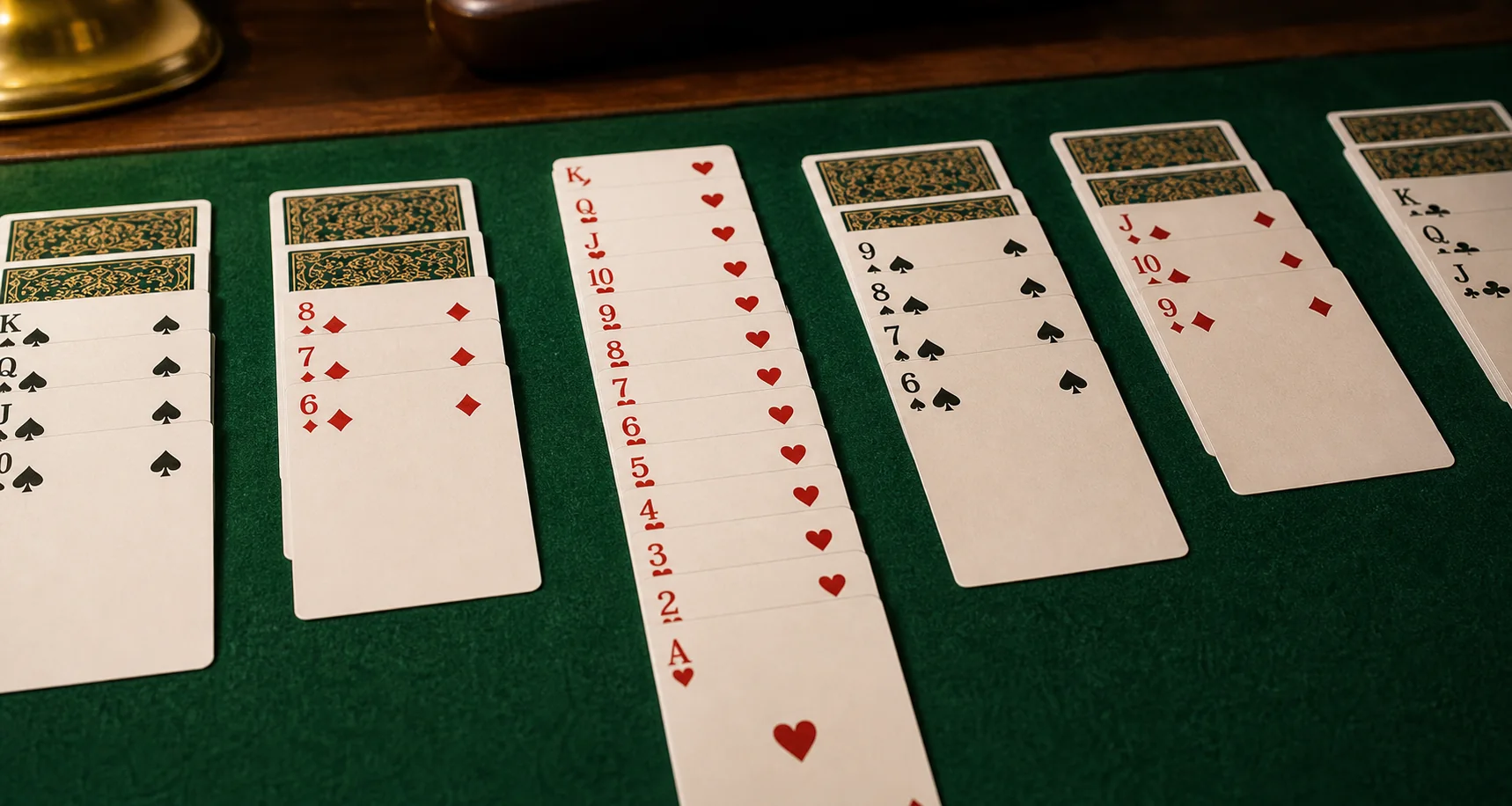
Card movement is the part of Scorpion Solitaire that surprises players most. The placement rule is strict: a card can be placed only on the next higher card of the same suit. The movement rule is loose: when that card moves, every card below it comes along. This combination gives the game its unusual texture. You are building precise suit runs while handling groups that may be anything but precise, which is where scorpion solitaire bliss often appears.
If you understand that tension, the rest of the game becomes easier to read. A move is not just the visible card you pick up. It is the whole tail attached to that card. Sometimes the tail is useful because it carries a partial run to a better home. Sometimes it is dead weight that blocks the target column. Before every move, inspect the tail as carefully as the destination.
The Same-Suit Rule
Scorpion does not use alternating colors. The 5 of Hearts goes onto the 6 of Hearts. The Jack of Clubs goes onto the Queen of Clubs. A card of the correct rank but wrong suit is not a legal target. This makes suit identity more important than color or rank alone. If you have played Klondike for years, this is the habit you must break first.
The same-suit rule means that each suit behaves like a separate lane. You are trying to bring scattered cards back into their proper lane, descending from King to Ace. The challenge is that the cards are buried inside mixed columns. A correct move may bring one lane together while dragging unrelated cards across the table.
The Tail Rule
When you move a face-up card, all cards below it in that column move with it. Those lower cards do not need to match suit, rank, or order. For example, if the 8 of Spades sits above a messy group and you move it onto the 9 of Spades, the messy group follows. The move is legal because the 8 connects to the 9. The attached cards are passengers.
This is why Scorpion can feel generous and punishing at the same time. You can rescue a buried card without first organizing everything above it. But you can also carry a problem into the only column that had room to breathe. A move that creates a legal top connection can still be strategically weak if the passengers clog the destination.
Moving to Empty Columns
An empty column accepts only a King or a group headed by a King. The cards under that King move with it, just as they would in any other transfer. This gives Kings special value. A King-led group can reopen a blocked lane, make room for suit building, or expose a hidden card in its original column.
Do not waste an empty column on the first King you see. Ask what the King move accomplishes. Does it reveal a face-down card? Does it place a useful sequence into a clean space? Does it free a card needed to finish a suit run? If the answer is no, the column may be worth saving for a stronger King move later.
Revealing Face-Down Cards
Face-down cards turn over when all face-up cards below them are moved away. Because only the first four columns contain hidden cards, your early game often revolves around loosening those columns. A move that exposes a hidden card is usually worth considering, especially if it also improves a suited sequence.
However, exposing a card is not automatically a good trade. If the only way to reveal one hidden card is to bury a nearly complete run under a long unrelated tail, you may be buying information at too high a price. The best reveals are clean: they open information while leaving the destination column usable.
Reserve Card Movement
The three reserve cards are dealt onto the first three columns. Once they land, they behave like ordinary face-up tableau cards. They can be moved according to the same-suit rule, and any cards below them move along if they are part of a transferred group. The reserve is simple mechanically, but strategically important because it changes three columns at once.
Because the reserve lands on columns that may still contain hidden cards, dealing it can delay reveals. Use it when the visible tableau has run out of useful moves or when adding new top cards is less harmful than staying stuck. If the first three columns contain exposed cards that are about to move, consider moving them before you deal.
Reading a Move Before You Make It
A practical way to judge any move is to ask four questions. Is the top connection legal by suit and rank? What cards will travel under the moving card? What card or space will be uncovered in the source column? What will the destination column look like after the tail lands? If you cannot answer those questions, slow down.
Scorpion rewards players who see movement as a transfer of structure, not a single-card action. The best moves join suits, expose hidden cards, preserve empty-column value, and keep messy tails from choking the board. The rules let you move a lot. Winning comes from moving only what the position can afford.