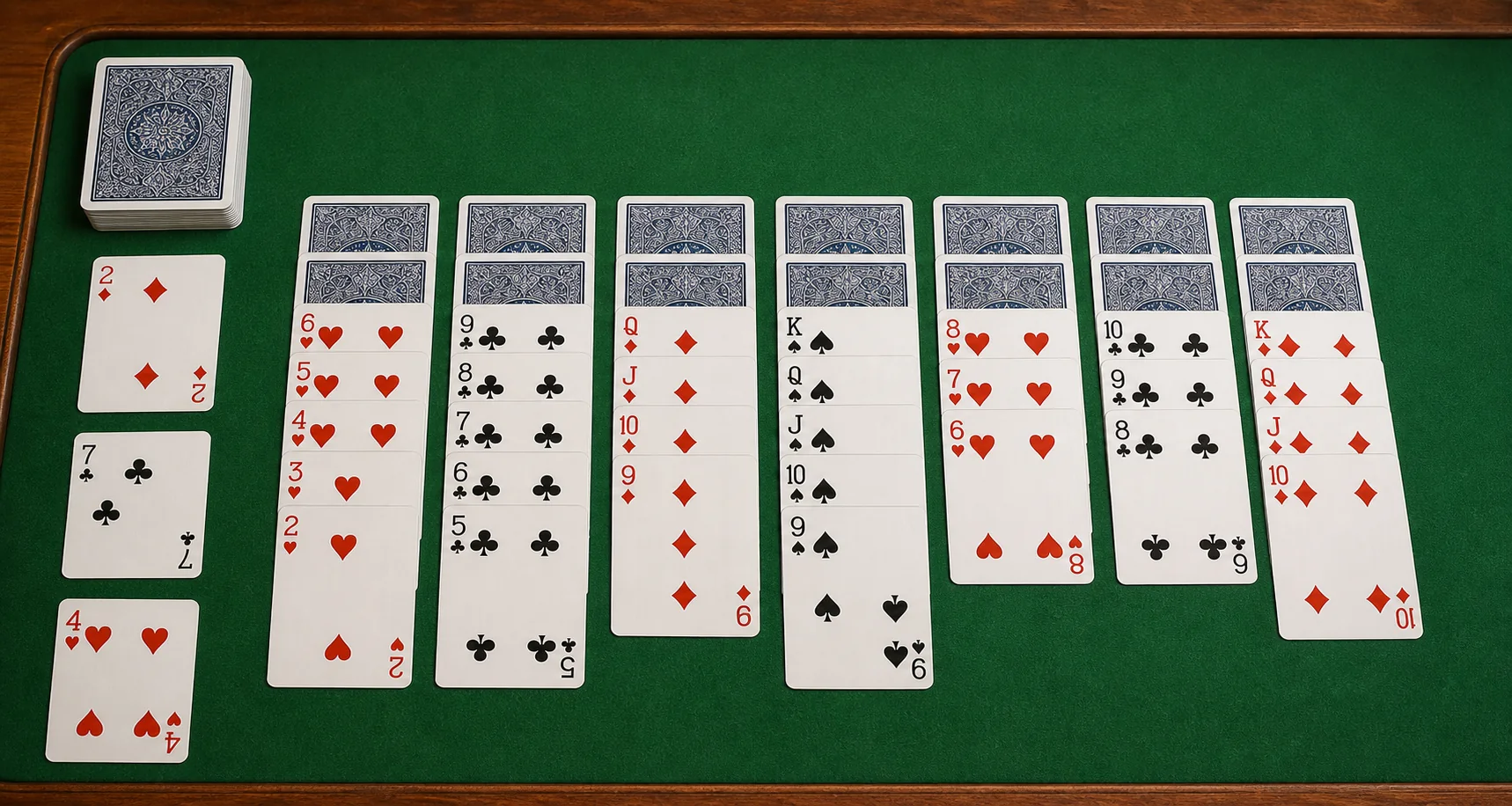
Scorpion Solitaire is a one-deck patience game with a simple aim and a demanding path. You are trying to build four complete sequences in suit, each running from King down to Ace. When a complete sequence is assembled, it can be cleared from the table. Clear all four suits and the game is won. The rules fit on a small card, but the consequences of those rules are what make the scorpion solitaire game worth playing.
The most important difference from many familiar solitaire games is that tableau building is by suit. Alternating colors do not matter. A 7 of Spades can go onto an 8 of Spades, not onto an 8 of Hearts or 8 of Diamonds. That single rule changes the whole feel of the game. You are not making temporary color ladders; you are trying to join the true suit families back together in descending order.
The Deal
Scorpion uses a standard 52-card deck. The tableau has seven columns. The first four columns receive seven cards each, with the first three cards in each of those columns dealt face down and the remaining four dealt face up. The last three columns receive seven face-up cards each. That accounts for forty-nine cards on the table. The final three cards are kept as a reserve, sometimes called the stock, and can be dealt later onto the first three columns.
This setup creates the central pressure of the game. Many cards are visible from the start, so you can plan. At the same time, twelve cards are hidden under the first four columns, and those hidden cards often include the missing pieces of a suit run. Good play is not just about making legal moves. It is about choosing moves that uncover the right unknown cards without wrecking the ordered material you already have.
Legal Tableau Moves
A face-up card may be moved onto a card that is one rank higher and of the same suit. The 10 of Clubs goes onto the Jack of Clubs. The 4 of Hearts goes onto the 5 of Hearts. Aces are the low end of a sequence and do not accept lower cards. Kings are the high end and become especially important because they are the only cards that can occupy empty columns.
When you move a card, every card below it in the same column moves with it. Those attached cards do not need to form a valid sequence. This is the rule that gives Scorpion its bite. You may move a 6 of Diamonds onto the 7 of Diamonds even if the cards hanging under that 6 are messy. The move is legal because the top connection is legal. The attached tail simply travels along, for better or worse.
Turning Hidden Cards
Whenever a face-down card becomes exposed because the cards beneath it have been moved away, it is turned face up. Exposing hidden cards is one of the most valuable things you can do, because each new card may complete a broken suit chain or release a King needed for an empty column. Still, not every reveal is worth any price. If uncovering one card destroys a nearly complete King-to-Ace run, the trade may be poor.
Beginners often chase hidden cards as if every reveal is automatically good. In Scorpion, the board can become worse after a reveal if the move used to create it drags a long, awkward tail into the only useful space. Think of hidden cards as targets, not commands. You want them, but you still need to reach them cleanly.
Empty Columns
An empty tableau column may be filled only by a King or by a group of cards headed by a King. This rule makes empty columns powerful but narrow. An empty space lets you move a King-led stack out of the way, rebuild a suit, or free cards trapped above a face-down card. But if no King is available, the space cannot accept anything.
Because of that, clearing a column too early can waste effort. A vacant column with no King ready to use it is just a blank square. A vacant column made at the right moment, with a King waiting, can solve half the deal. Before you empty a column, look for the King that will occupy it and ask what that King will release next.
The Three Reserve Cards
The reserve contains three cards. When dealt, they are placed onto the first three tableau columns. The reserve is not a draw pile you cycle through repeatedly; it is a one-time addition. It can unlock a stuck layout, but it can also cover useful cards and make a crowded board worse. Most players do better when they delay the reserve until the tableau has no strong moves left.
There are exceptions. If the board is frozen and the reserve is the only way to introduce new material, use it. If the first three columns are already messy but have no immediate prospects, the reserve may not hurt much. But when those columns hold exposed cards you still need to move, dealing the reserve can bury them under fresh problems.
Winning the Game
A full suited run from King down to Ace is removed from play. For example, King of Spades, Queen of Spades, Jack of Spades, and so on down to Ace of Spades forms a complete spade run. Remove all four suit runs and the game is complete. Unlike foundation-building games, Scorpion does not ask you to move cards one at a time to foundation piles. The tableau itself is where the finished sequences are made.
The cleanest wins usually come from steady suit consolidation. You connect partial runs, open columns for Kings, reveal hidden cards, and use the reserve only after the visible board has been worked honestly. The rules are not complicated, but they are strict. Once you understand how suit building, moving tails, empty columns, and the reserve interact, every deal becomes a compact tactical puzzle.