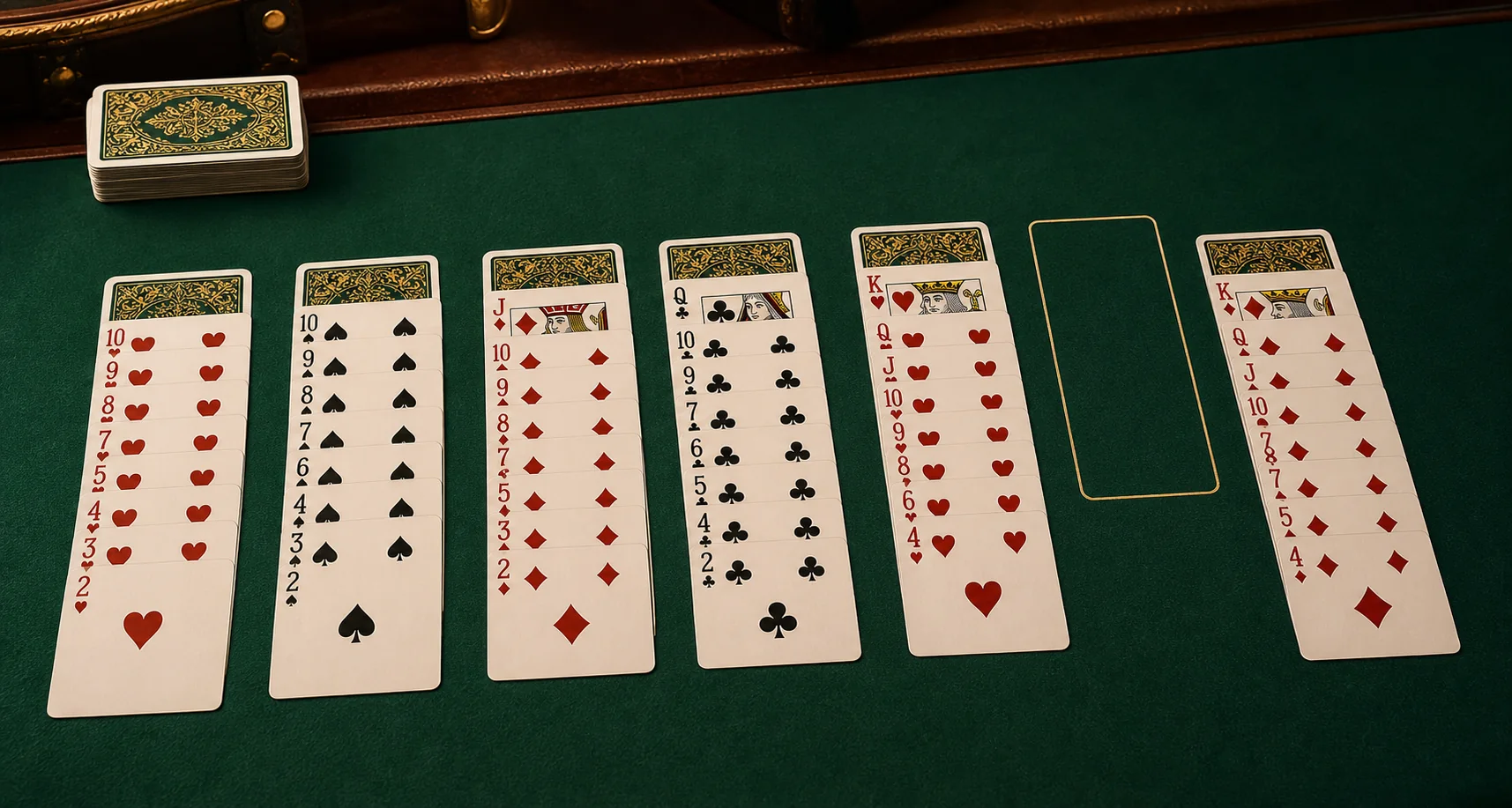
Winning Scorpion Solitaire is not about finding the first legal move. Legal moves are common. Good moves are rarer. The game gives you enough freedom to move messy groups around the tableau, and that freedom can make a bad position look active for several turns before it finally locks. A strong strategy begins with restraint: move when the board improves, not merely because a card fits. If you want to practice these ideas directly, start a fresh scorpion solitaire game on the main page.
The board has three resources: hidden cards, empty columns, and clean suited runs. Hidden cards give you new information. Empty columns give you mobility. Clean runs give you a path to removing cards from the game. Most winning decisions improve at least one of those resources without damaging the others too badly. When a move does none of that, leave it alone.
Read the Board Before Moving
Start each deal by scanning for partial suit chains. Look for Kings with Queens below them, Queens with Jacks available, and low cards that are already close to their natural homes. Also notice which suits are scattered. A suit split across too many columns will need space later, so do not use your best empty-column opportunity on a move that only tidies one card.
Next, identify the face-down cards in the first four columns. You do not know their ranks, but you know they are the information bottleneck. A column with several hidden cards above a movable face-up section deserves attention. If you can expose a card while also joining a suited sequence, that is often a premium move.
Protect Clean Runs
A clean run is a descending same-suit sequence already in order. It may be short, such as 9-8-7 of Clubs, or it may be nearly complete. Treat those runs as working capital. You can break or move them when necessary, but do not turn them into storage for unrelated cards. The fewer mixed tails attached to a good run, the easier it will be to finish and clear.
One useful habit is to ask whether a move makes a run longer or merely makes a column taller. A longer run brings you closer to removal. A taller column may only hide the next useful card under more clutter. Scorpion rewards consolidation, not height.
Use Empty Columns With a Purpose
Empty columns are the strongest tactical tool in the game because only Kings can enter them. That restriction makes timing important. If you open a column before a King can use it, the space may sit idle. If you open it at the moment a King-led group can move, you may unlock an entire suit chain or uncover several hidden cards.
Before clearing a column, look for the best King candidate. A King with an orderly tail is usually better than a King dragging a chaotic block. A King that frees hidden cards by moving is better than one that merely relocates from one visible stack to another. The empty column should start a plan, not end one.
Delay the Reserve
The three reserve cards are tempting because they promise new possibilities. They also land on the first three columns, which are already the columns most likely to contain hidden cards. If you deal the reserve too early, you can cover cards that still had work to do. In many games the best time to deal the reserve is after the visible tableau has been mined for meaningful reveals and suit joins.
There are positions where dealing early is correct. If no productive tableau move exists and the first three columns are not protecting valuable exposed cards, use the reserve. But do not treat it like a harmless refresh button. It is a one-time shock to the board, and shocks are easier to survive after you have created room.
Prefer Moves That Reveal and Connect
The best Scorpion moves often do two jobs. Moving a 6 of Hearts onto a 7 of Hearts is useful. Moving that 6 in a way that also exposes a face-down card is better. Moving it while keeping a King lane open is better still. Since every move drags a tail, you need each transfer to earn its disruption.
When two legal moves compete, choose the one that improves the future board. A move that creates a complete or nearly complete suit run usually beats a move that only uncovers one unknown card. A move that uncovers a card in a deep hidden column usually beats a cosmetic rearrangement of visible cards. Keep asking what the board will look like two turns after the move, not just one turn after.
Know When to Leave a Card Alone
Scorpion has many false invitations. You may see a legal same-suit placement and feel that it must be used. But if the moved card has a long tail of unrelated cards, the move may block the target column and remove your only route to a hidden card. Passing is a real strategy. A card can be legally movable and strategically parked.
The best players are comfortable with temporary disorder. They do not need every visible card to sit on its matching suit immediately. They wait until the move creates space, reveals information, or helps complete a run. That patience turns Scorpion from a scramble into a controlled puzzle.