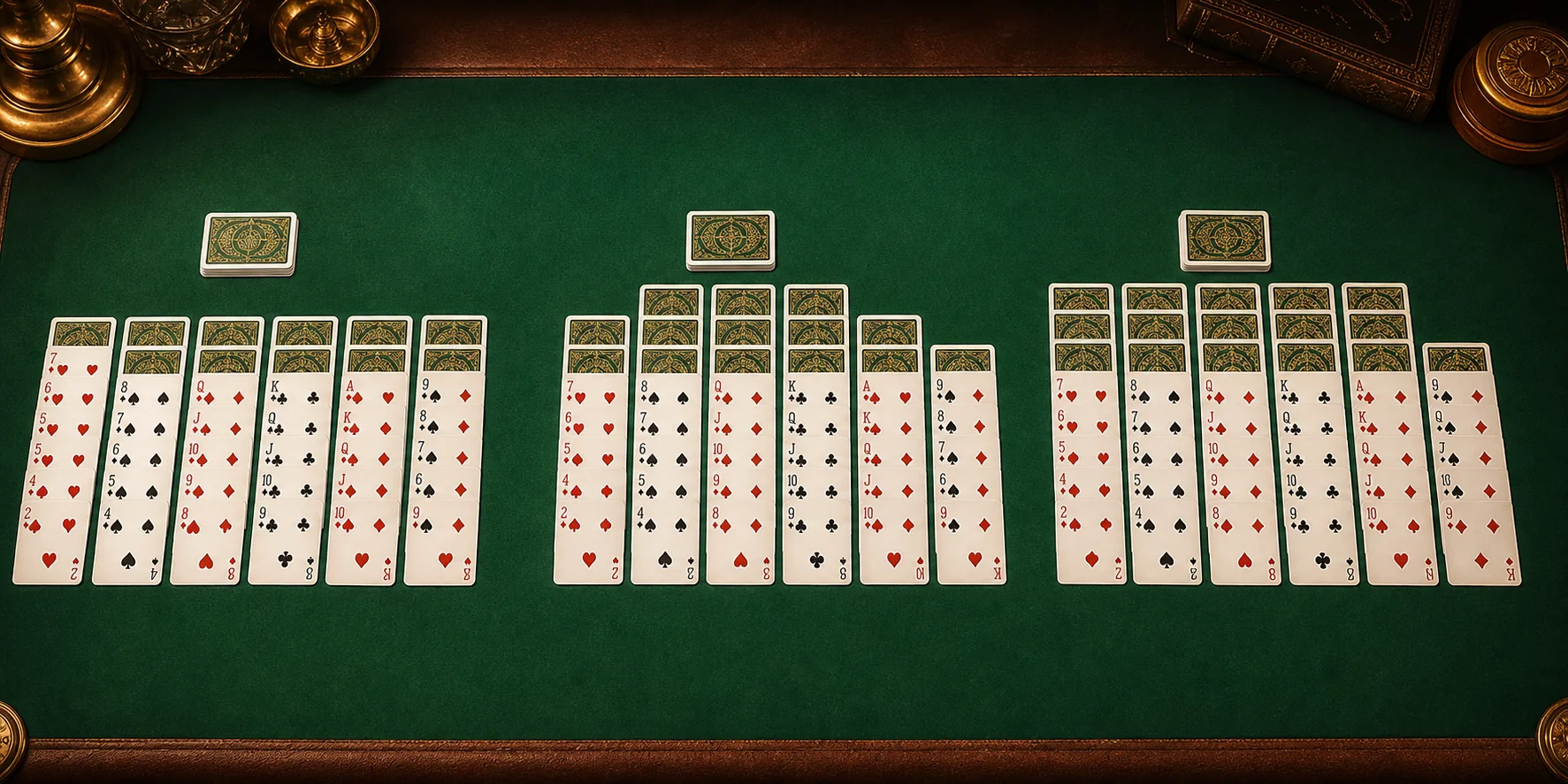
Scorpion Solitaire has a strong standard form, but small rule changes can make it friendlier, harsher, or simply different. Because the core game is compact, every variation matters. Changing how many cards are hidden, how empty columns work, or when reserve cards appear can shift the experience from approachable puzzle to stubborn test of patience. The standard scorpion solitaire game is still the best baseline for comparing variants.
Understanding the variants helps you choose the right game for your mood. If you are learning, an open or simplified layout can teach the movement rules without too many dead ends. If you already know the standard game, harder variants can make familiar decisions feel fresh again.
Standard Scorpion
Standard Scorpion uses one deck, seven tableau columns, twelve face-down cards in the first four columns, and three reserve cards. Cards build down by suit, only Kings can fill empty columns, and a complete King-to-Ace suited run is removed. This is the version most players mean when they refer to Scorpion Solitaire.
The standard version is demanding because it balances visible information with hidden pressure. You can plan from the start, but you cannot see everything. The reserve is small, so it offers a little help without turning the game into a draw-pile exercise. This is the best default for regular play.
Open Scorpion
Open Scorpion removes the hidden-card problem by dealing every tableau card face up. The movement rules remain the same, but the uncertainty disappears. That makes the game easier to analyze and better for learning. New players can see why a move works or fails without guessing what might be buried underneath.
The tradeoff is that Open Scorpion loses some of the original tension. Revealing hidden cards is one of the main rewards in standard Scorpion. Without hidden cards, the game becomes more like a pure arrangement puzzle. It is still useful, especially for practice, but it has a softer edge.
Relaxed Empty Columns
Some digital versions loosen the empty-column rule and allow any card or sequence to fill a vacancy. This makes the game much easier because empty columns become general workspaces instead of King-only lanes. It also changes the strategy. You can separate suits more freely, rescue buried cards more often, and recover from messy tails with less punishment.
This version can be enjoyable, but it should not be confused with standard Scorpion. The King-only empty-column rule is one of the main reasons the original game has teeth. Remove it and many difficult positions become manageable through storage rather than careful timing.
Harder Hidden Layouts
A harder variant can increase the number of face-down cards or place hidden cards in more columns. This raises the value of early reveals and makes the reserve more dangerous. The player must work with less information and fewer clean paths. Such layouts are best for experienced players who already understand standard Scorpion movement.
The risk with harder layouts is that some deals can feel locked before meaningful play begins. A good hard variant should still give the player decisions. If the game becomes mostly waiting for luck, it loses what makes Scorpion interesting.
Difficulty Compared With Spider
Scorpion is often compared with Spider because both games care about complete suited runs. Spider is longer and more expansive, especially in four-suit mode. Scorpion is shorter but sharper. It gives you fewer cards, fewer reserve options, and less room to hide a mistake. A bad Scorpion move can hurt immediately.
For players who find Spider too long, Scorpion offers a satisfying alternative. It keeps the pleasure of building full suit sequences while delivering a tighter session. For players who want a gentler entry, Open Scorpion or relaxed empty columns can bridge the gap before returning to standard rules.
Choosing the Right Variant
If you are new, start with standard rules but do not hesitate to study open layouts. They teach suit lanes, tail movement, and King placement clearly. Once the movement feels natural, standard Scorpion gives the best balance. If you want a tougher challenge after that, experiment with stricter hidden-card arrangements or simply track your win rate under standard rules.
The best variant is the one that keeps decisions meaningful. Scorpion Solitaire works because every rule supports the same central question: can you build complete suit runs before the tableau closes around you? Whether the layout is open, standard, or difficult, that question should remain at the center of play.